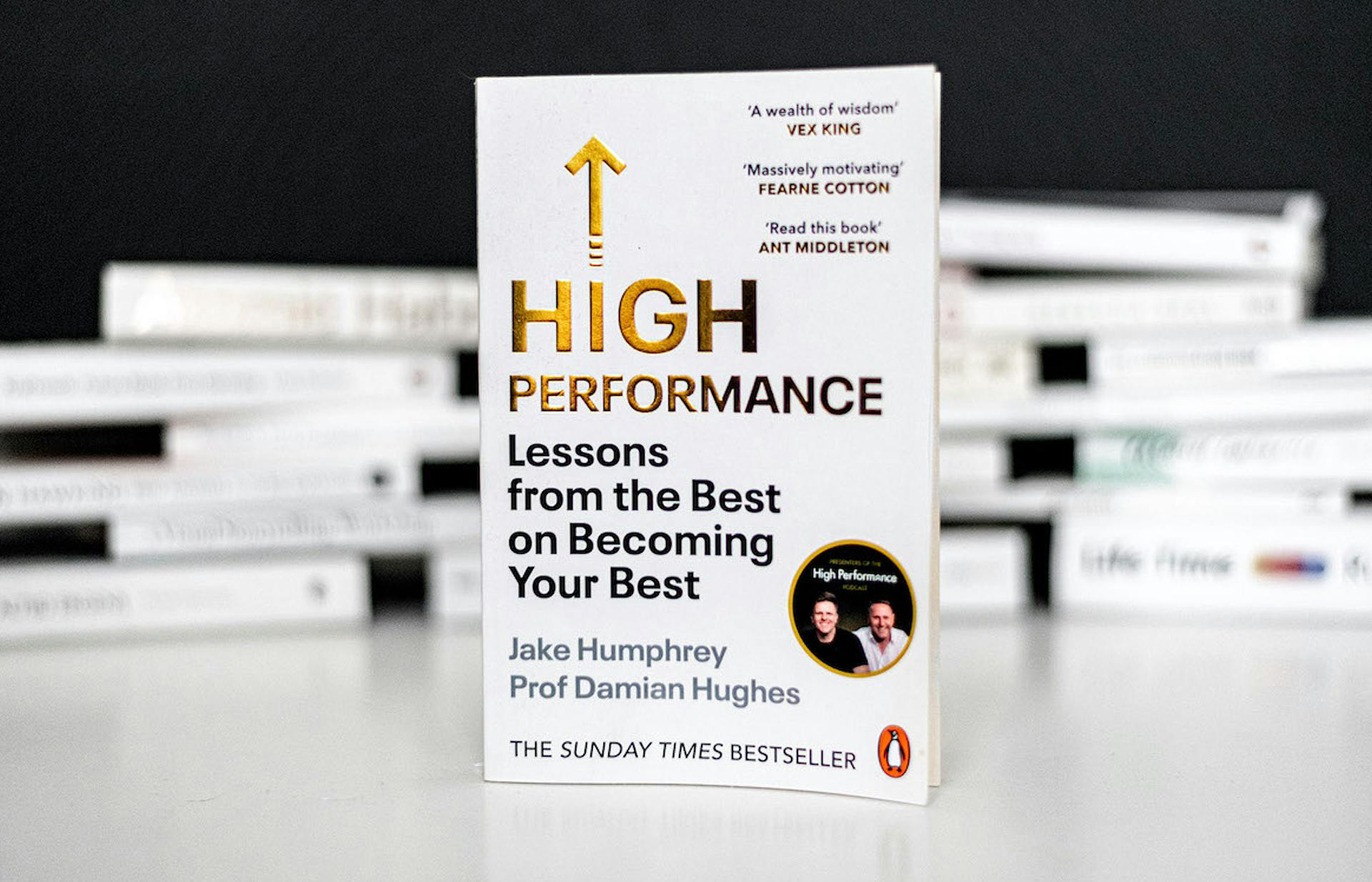
By Jake Humphrey and Damian Hughes
'High Performance: Lessons from the Best on Becoming Your Best' is written by Jake Humphrey, broadcaster and founder of the High Performance Podcast, and Professor Damian Hughes, organisational psychologist, bestselling author and trusted advisor to elite sports teams and global businesses.
Together, they bring decades of insight from working with Olympic athletes, world-class sports teams, military leaders and senior executives, translating elite performance principles into practical, human strategies for everyday leaders.
Their central message is clear. High performance is not about relentless pressure or hustle. It is about building the conditions that allow people and organisations to perform at their best, consistently.
The book reframes high performance as a set of repeatable behaviours rather than rare moments of brilliance. The highest performers are not always the most talented or the busiest. They are the most intentional.
Humphrey and Hughes highlight several consistent themes seen across elite performers:
High performance is therefore not an event. It is a system.
Clinic ownership is uniquely demanding. Leaders are often required to be clinician, manager, decision maker and culture carrier simultaneously. Without structure, this leads to burnout, reactive leadership and stalled growth.
The authors’ work is particularly relevant to clinic owners because it focuses on sustained performance in high-pressure environments, not short-term motivation.
One of the strongest messages in the book is the power of clarity. High performers are clear on what matters most and eliminate distractions that dilute focus.
For clinic owners, this means:
Busy clinics are not always high-performing clinics. Clear clinics are.
Drawing on psychology and performance science, the authors emphasise that performance drops when physical, mental and emotional energy is depleted.
In a clinic environment, energy directly affects:
High-performing clinic owners protect sleep, nutrition, movement and recovery not as wellness extras, but as leadership responsibilities.
Humphrey and Hughes repeatedly highlight that elite performers rely on standards, not mood. They show up consistently because systems remove reliance on motivation.
In clinics, this translates into:
Consistency builds trust. Trust builds growth.
The book draws heavily on examples from elite sport to show that emotional regulation is a defining leadership skill. Clinics are high-stakes environments where stress, patient expectations and operational issues are constant.
The ability to pause, respond thoughtfully and lead calmly under pressure directly shapes team confidence and performance.
One of the most impactful insights is the authors’ insistence that recovery is non-negotiable. High performers plan recovery with the same discipline as performance.
For clinic owners, this may include:
Recovery is not time off from leadership. It is an investment in it.
The book leaves clinic owners with several powerful reflections:
How you show up sets the ceiling for your business.
'High Performance: Lessons from the Best on Becoming Your Best' reminds us that excellence is not about pushing harder. It is about leading better.
For clinic owners, the opportunity is not to do more treatments or work longer hours. It is to build the personal and professional systems that allow you, your team and your clinic to perform at a high level consistently.
That is where meaningful, long-term growth begins.