What only you and your clinic can control as technology changes everything around you
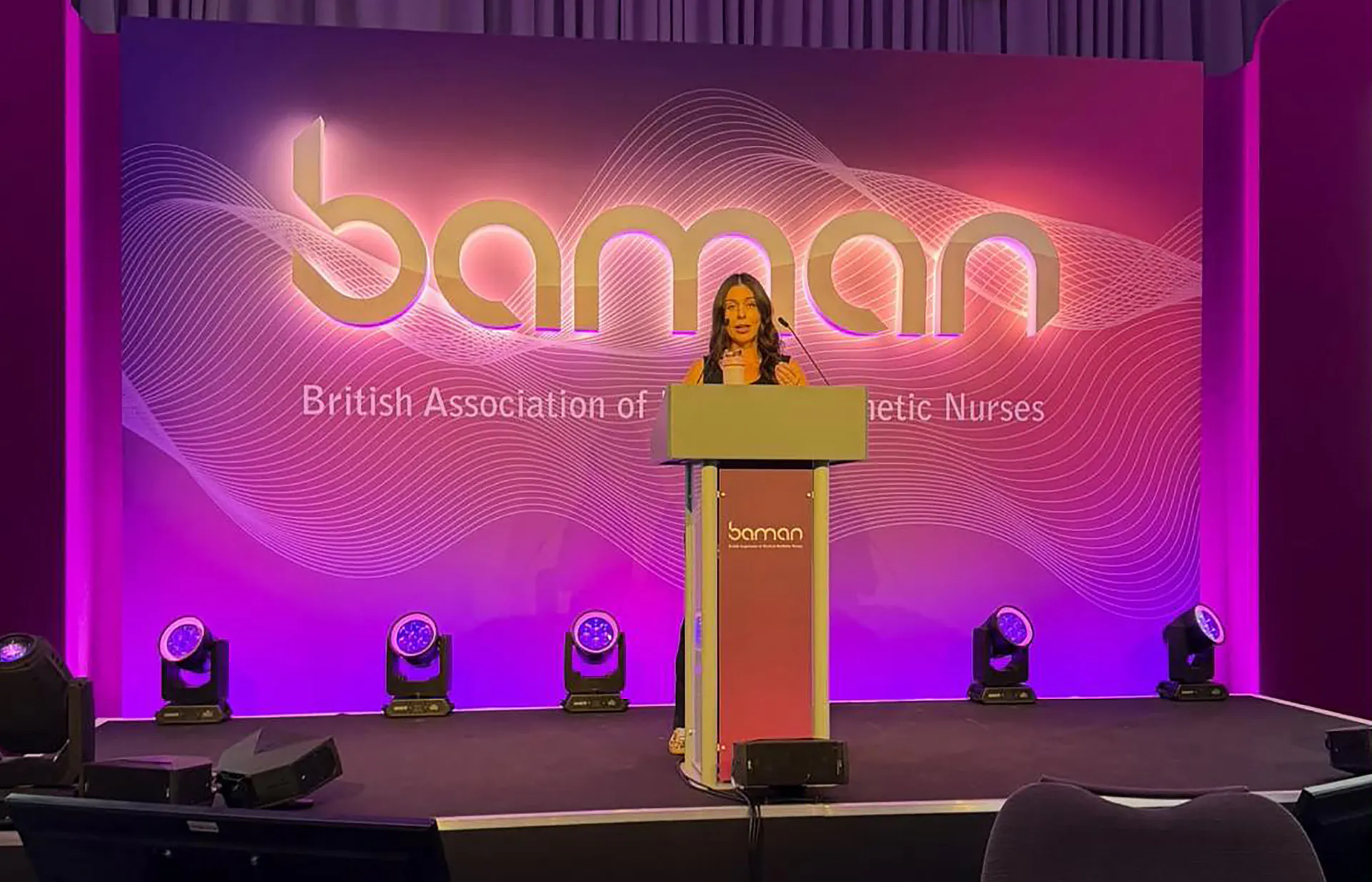
At the recent BAMAN Autumn Aesthetic Conference, Hosted Aesthetics Founder Courtney Le Borgne took to the stage to explore a question facing every clinic owner:
What can you control when everything seems so uncertain?
AI is changing how people search, how content is created and how businesses communicate. Trust and influence are shifting, consumers are scrutinising value more carefully, costs are increasing and patients have more choice than ever before.
Clinic owners therefore need to understand those changes, but they do not need to compete with all of them. While algorithms, search behaviour, new platforms, competitor content and increasingly accessible technology will continue to change, there is another group of things that remain firmly within a clinic owner’s control: the people you choose to serve, how deeply you understand them, the conversations you create, the experience inside your clinic, how recognised people feel and what your clinic stands for.
That is the Human Advantage.
Human connection can sometimes sound like a softer business concept. In reality, it influences whether somebody chooses you, trusts you, returns, recommends you and remains connected to your clinic and that makes it commercial.
As technology becomes more accessible, many of the traditional ways clinics differentiate themselves become easier to reproduce. Competitors can access similar devices, products, platforms and marketing tools. What is considerably harder to replicate is human judgement, understanding, recognition, trust, relationships, conversation, shared experiences and belonging.
So, rather than only asking what should we offer next?, there is another question worth asking: What can my clinic create that a platform or competitor cannot easily reproduce? The answer may begin with understanding your patients better than somebody else does.
Gymshark did not invent activewear. Good American did not invent jeans. House of Gods did not invent hotels. What differentiated each business was how deeply it understood the people it wanted to serve and how deliberately it built around them.
Gymshark grew from inside an emerging conditioning community, developing early relationships with fitness creators and bringing its audience together through expos, pop-ups and shared training experiences. Its advantage was not simply the product. It understood who the product represented.
For clinic owners, there is an important question within that: which patients do you understand from a depth of experience that a larger competitor may never acquire? That understanding might come from years of treating a particular patient demographic, recognising the same concerns repeatedly or simply having conversations that reveal something a larger or more generalised competitor would struggle to see.
Good American provides a different lesson. After launching an inclusive size range, the business noticed significantly higher return rates around sizes 14 and 16. Instead of accepting the data, it investigated it, brought women within that sizing gap into the process and ultimately introduced size 15. The opportunity for a clinic is to apply the same curiosity to its own business. Are there trends in your data that could lead to improvements if you better understood the patient behaviour behind them?
It could be an unusually high rebooking rate for one treatment, a particular patient group investing across several services, a point in the journey where enquiries regularly disappear or a recurring question the team hears in consultations. The number itself is only the beginning. The opportunity comes from understanding why it is happening and deciding what to do with that information.
Then there is House of Gods, whose Founder Mike Baxter summed up another part of the opportunity in two words at our 2026 Leadership Summit: “Be memorable.” The business understood its customer well enough to design distinctive moments around them, from milk and cookies to calling for prosecco to be delivered to the room. For a clinic, being memorable does not have to mean expensive gestures or an elaborate patient journey. It means understanding your patients well enough to know which moments matter to them, then deliberately designing those moments rather than leaving them to chance.
Where in your own patient journey could you create an experience somebody genuinely remembers?
Across all three examples, the process is remarkably simple: Listen. Identify. Take action.
Perhaps the most important distinction within The Human Advantage is between having an audience, building a community and creating a genuine sense of belonging. An audience knows you. A database allows you to contact people. A membership gives people access. A community connects people through participation. Belonging describes how somebody feels within any of them and that feeling develops when people feel understood, safe, recognised and connected to a shared identity, and when the relationship has continuity beyond an individual transaction.
For a clinic, that could mean remembering something about a patient beyond their treatment history, creating an environment where they can discuss concerns without judgement, reflecting their experiences in your communication, giving them ways to participate rather than simply purchase or maintaining a relationship between appointments. None of those things requires an enormous investment. They require attention.
The opportunity is to look at the patient journey through this lens and ask: what is one moment you could redesign to make somebody feel more understood, recognised or included? It could be the first enquiry, the consultation, the way somebody is welcomed back, how previous conversations are remembered or what happens between appointments. The important part is that the experience is designed around what makes that particular patient feel understood, rather than simply what makes the process efficient.
Creating belonging becomes considerably harder if you are trying to create it for everybody. Who is your clinic especially well placed to serve? It could be women navigating menopause, postpartum patients, people interested in healthy ageing, patients living with a particular skin condition, male patients or a specific local community.
Underneath all of this sits an even bigger leadership requirement: clarity about the business you are building. Your mission, vision and values should provide the North Star for those decisions. Why does your clinic exist beyond delivering treatments? What are you building towards? Who have you chosen to serve particularly well? What role do you want your clinic to hold in their lives? Without that clarity, it becomes very easy to react to whatever the market is doing next. With it, decisions become much easier.
Start smaller than you think
Building stronger human connection does not mean launching a membership, creating a community platform or completely redesigning the patient journey tomorrow. The framework Courtney shared at BAMAN was deliberately simple: Listen. Define. Create. Build. Continue.
Listen to what your patients are actually telling you. Define who you want to serve particularly well. Create something that responds to what you have learned. Build it into the experience so it can be delivered consistently. Then continue listening and improving.
What is the smallest thing you could build to test what your patients actually need from you? It could be changing one question in a consultation, setting new conversation standards across the team, using previous notes more thoughtfully, picking up the phone rather than automating a message, identifying a pattern in your patient data or redesigning one point in the journey where people currently feel unseen.
The objective is not to reject technology. Use it wherever it makes the business stronger. The opportunity is to recognise the moments where replacing a human interaction with technology could actually make the experience weaker.
Technology will continue to change. Economic uncertainty will continue to influence how people spend. Competitors will continue to access many of the same products, devices and marketing tools. Those things sit outside your control.
What remains within it is how deeply people feel understood, how safe they feel in your care, whether they feel recognised and whether choosing your clinic gives them a sense that they belong.
The Hosted takeaway? The answer to a more competitive, technology-led market is not necessarily to do more. Listen more closely. Understand who you are uniquely placed to serve. Look for the needs others have overlooked and deliberately build those insights into the experience your clinic creates. Because that feeling of being understood, recognised and belonging is extraordinarily difficult to automate, imitate or compare on price. That is your Human Advantage.